How A Mobile-Learning Pod Can Make You Smarter!
On our ongoing odyssey in search of knowing about stuff we didn't know until we went looking for it.

When a friend got into the passenger seat of our car not long ago, she was surprised to see that she couldn’t extend her legs because a bunch of books were arranged side-by-side on the floor mat in the foot space beneath the glove compartment which was supposed to allow for feet.
“Oh!” she said, seemingly disoriented, as if she’d just seen a snake in a bathtub. “You have a library on the floor of your car.”
It isn’t the kind of library that has a Dewey-Decimal-System order. I tried to explain that they’re just the books my wife reads aloud to provide a literary soundtrack to our ramblings (25,000 miles last year). We’ve discovered that one way to get smarter instead of dimmer in later life — (“Honey, what’s that word for the thing that you turn a screw with?” “You mean screwdriver?” “Yeah, that thing”) — is to constantly put new things into our heads by driving around America while M. reads out loud, so that while we’re looking at rolling landscapes and rural crumbling service stations, or lovely 19th-century courthouses anchoring timeless town squares, or spooky lost industrial ghettos on the wrong sides of whatever city, we’re also listening to fantasy novels, historical novels, and sometimes nonfiction ones if the writer is skilled enough to animate the subject and tell a story inside of joining facts to other facts.
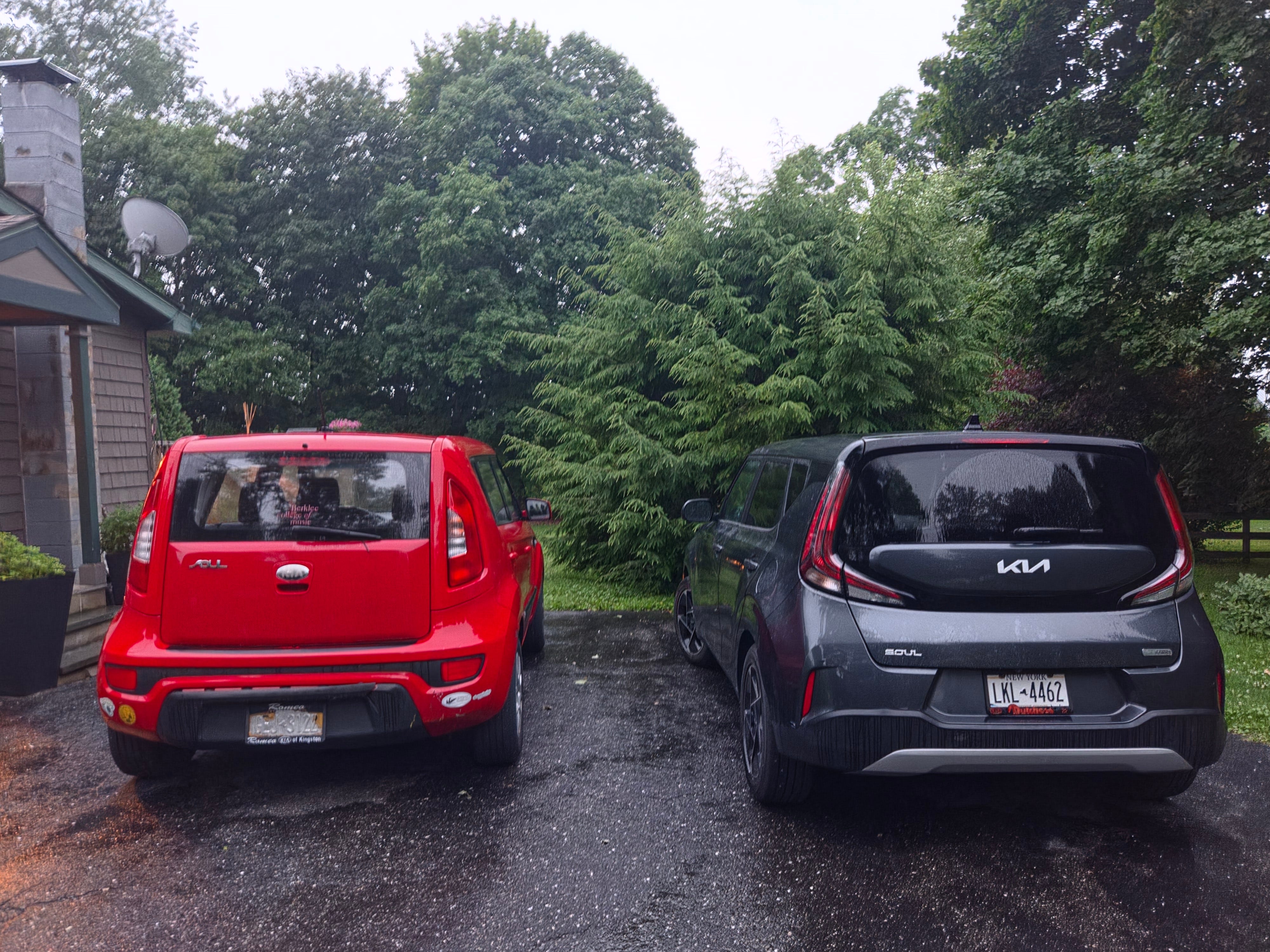
My friend’s expression made it clear that there wasn’t a single lobe in her brain that could take my story in, because so many things appeared wrong, just on the face of it. Like to start, the mileage we put in every year. About the same as the circumference of the planet? Really? Well, yeah. It’s fun when every mile tells a tale. We’ve put 347,000 on our two Souls in 13 years, which is to the moon and halfway back. The mechanic whose shop has raised both cars happens to have some F-1 experience, so mechanical issues never come up, and the newer one (r.) gets 40 to the gallon, so.
Or: Who could possibly enjoy reading aloud when the driver is steering around deep-Appalachian bends on Virginia’s 330-mile “Crooked Road: The Heritage Music Trail?” She does. I am a good enough driver to make sure that when I’m swerving through mountains I do so slowly, so as to not interrupt the narrative.
*
It’s not just what we learn from the books themselves. Our rules demand the right to call a sidebar at any point in a story to further explore any topic through telephonic research, going off on tangents, down alleys, sort of like David Foster Wallace footnotes, in that they tend to last a long time and wander wonderfully afield.
For example: Maybe we’re cruising on a gently rolling completely deserted state highway in western Georgia surrounded by soy and corn and scrub fields, maybe one car coming the opposite way every minute or so, because the interstate turned it into a hundred miles of forgotten pavement, so it’s a very peaceful and relaxing road to cruise when you’re searching for a fried whitefish sandwich at the next crossroads.
Meantime, reading Simon Pare Poupard’s “Trash,” the history of garbage, she might come across a reference to Louis Cyr, the strongest man in Quebec in the 1890s when people competed to be Strongmen. I would then call for a sidebar, and ask, “How did Louis Cyr train?” She would insert the bookmark at the given page, close the book, consult her phone and then explain that Cyr’s strongman idol had been Milo of Croton (550-511 B.C.), a fabled wrestler who, legendarily, carried a calf on his shoulder as a child to gain strength and carried it until it was a full-grown cow. But Cyr’s first calf kicked him so much he resorted to carrying a bag of grain for a quarter mile each day, as a kid, adding more grain to the bag until, I guess, he was carrying a farm or something.
Sometimes we learn more about something we thought we already knew about, but were wrong. Recently, we had to settle a debate about whether it was Byron or Keats who’d drunkenly died sailing in a gale, but it turned out to actually be Shelley, who was carrying a Keats poem in his pocket, so we’d been close.
(Also, rules-wise, we are both allowed to correct grammar when it needs correcting. If the author writes, “She acted like she was prom queen,” one of us will instantly say, “she acted as if she were prom queen, right?”)
In truth, she doesn’t so much narrate books as perform them. She does accents from countries she’s never been in. She gesticulates, suddenly throwing out an arm or something when it’s called for. She particularly seems to like it when one of her characters gets to accentuate variations of the word “FUCK,” like the other day when she was narrating the character of an aging stripper in Willy Vlautin’s, “The Left and the Lucky,“ and there were seven or eight “fucks” in a single tirade, and she brought a different nuance to each one. Those were her best “fucks” ever. If they make a movie, they should hire her to dub Connie the stripper.
She also did a stunning young-girl voice of a vacuum cleaner named Scout in Glenn Davis’ brilliant “The Infinite Sadness of Small Appliances.”
As for what we’re looking for roaming the physical world, it’s nothing specific, more like just wanting to learn how the rest of the country is living their lives, and getting by and sometimes enjoying and sometimes even revelling in living in their town, hamlet, county, village, or small, off-the-radar city. Their buildings, their homes, their antique stores, their cheeseburgers. How they do what they do to keep coming back for more of the same life every day. You’d be amazed at how many people you can meet that you’d never have met in your own world when you drive every day.
Sometimes we can even be helpful. One day we rambled into the North Brevard (FL) Historical Museum in a former shoe store in Titusville, near Cape Canaveral, and when we asked the two women up front about the large piece of a panel from a space vehicle on the floor of one of the booths in the back, they didn’t know they had it.
*
When we’re not on the annual seven-week 6,000-mile Southern Grinch Odyssey in the dead of winter, back home, it’s never hard to find an excuse to put in a good 70 or 100 miles to get to the next chapter of, over the last months, “Seek Immediate Shelter,” or “Martyr,” or “The Memory Police,” or “My Murder,” or “The Horse, or “The Anomaly,” or “West With Giraffes,” or “Endlings,” or The Bog Wife.” (We gave up quickly on ”The Jellyfish Problem,” partly because of the sentence, “The jellyfish held all the answers; the challenge was to get it to share them.”
Say she realizes she needs a certain brand of furikake or Cameroon pepper from the Asian market up in Albany for this dish she’s making for the mechanics at Alex’s shop. who work so brilliantly on our transportation. Or maybe she needs the large-size can of dried milk from the African shop in Pittsfield that also sells nurses’ uniforms. Or the Turkish Labneh from the European Market in Waterbury.
Or maybe I suddenly realize I need a new long-sleeved black tee-shirt from the Target in Wappingers Falls, or a candle from the Marshall’s in Poughkeepsie. Maybe we just need a pizza from Anthony’s in Torrington, or the fish and chips from the Pakistani place in Danbury. a mile from KK Asian Market. Or, lots of the time, a book must be returned to one or another of our regional libraries, where she’ll get another one.
Some of her books show up in mainstream research, and some on book sites you and I have never heard of. Other times she’ll simply have bonded with a book’s cover art and fonts, because covers involve graphic expertise; we will never read a book where the author’s name appears in raised gold letters. Our favorite source is an author friend whose wife is an editor with a corner office in Big-Publishing Land. When we come back after a day on the road, and David’s left a book, it’s a good day.
Sometimes she’ll choose a book because it’s a translation, because we both think that sometimes books are better when they’ve been translated because the translator has put so much rigor into the translation to get it right that it might be better than what the author intended in the first place, like Sayaka Murata’s “Convenience Store Woman,” originally published in Japanese, and Matias Faldbakken’s “The Waiter,” originally published in Norwegian, both about anonymous people serving other people, with no actual plots to the narratives, just mini-subplots, both brilliantly entertaining. Riveting. No one seems to write like well-translated Japanese writers.
*
In conclusion to this paper, I’d say that the best thing about going for a Masters in Everything is that the research is the point, not the destination. The research never ends, like the roads. Or the reading list. Or the pork banh-mi sandwiches.